Play. Break. Build.

Security. AI.
Mission Software.

We build and evaluate
intelligent software systems.

An independent engineering lab
and product studio.

Build the system.
Then ask harder questions.

Same system.
Three questions.

Intelligence is useful when the work holds up to inspection.

Operate inside complex systems.

Can it operate inside complex simulated environments, make a plan, adapt, and reach a measurable goal?

Find where systems fail.

Can adversarial testing expose failure modes, security weaknesses, regressions, and assumptions that do not hold?

Turn requirements into working systems.

Can it engineer and verify resilient systems, inspect the actual artifact, and improve it without breaking what works?

One environment. Different questions.Operating
An agent operating inside a bounded environmentPlay follows a task through an agent into an environment. Break exposes an unchecked boundary. Build adds verification before the artifact is accepted.Controlled environmentTaskAgentResultVerifyUnchecked boundaryAn agent operating inside a bounded environmentEnvironmentTaskAgentResultVerifyUnchecked
Boundary model · illustrative schematic

Play follows the task into the environment. Observe the result, then adapt.

Built to be examined.

All systems

Cavrino

Decisions need a history.

Market intelligence and decision support for collectible card markets. Reconstruct the evidence, inspect the assumptions, and separate a decision from its outcome.

The engineering question: can we reproduce what the system knew at a particular moment?

Explore Cavrino
CavrinoPoint-in-time replay
Evidence available
ObservedRetainedVersioned
Observe → reconstruct
DecisionCutoff
Later information
CorrectionsRevised labelsFuture outcomes
Excluded from the decision
What was known then. What happened next.Evidence boundary · schematic

Parignal

Evidence before confidence.

A property-analysis workflow that brings lead triage, underwriting, and renovation planning back to inspectable sources and explicit assumptions.

The engineering question: what should a system refuse to conclude when evidence is missing?

Explore Parignal
ParignalEvidence-backed property analysis
Evidence

Sources
Comparable sales
Known gaps

Assumptions

Scope
Cost ranges
Uncertainty

Approval

Review the scope
Confirm the inputs
Own the decision

Confidence has to follow the evidence.Decision boundaries · schematic

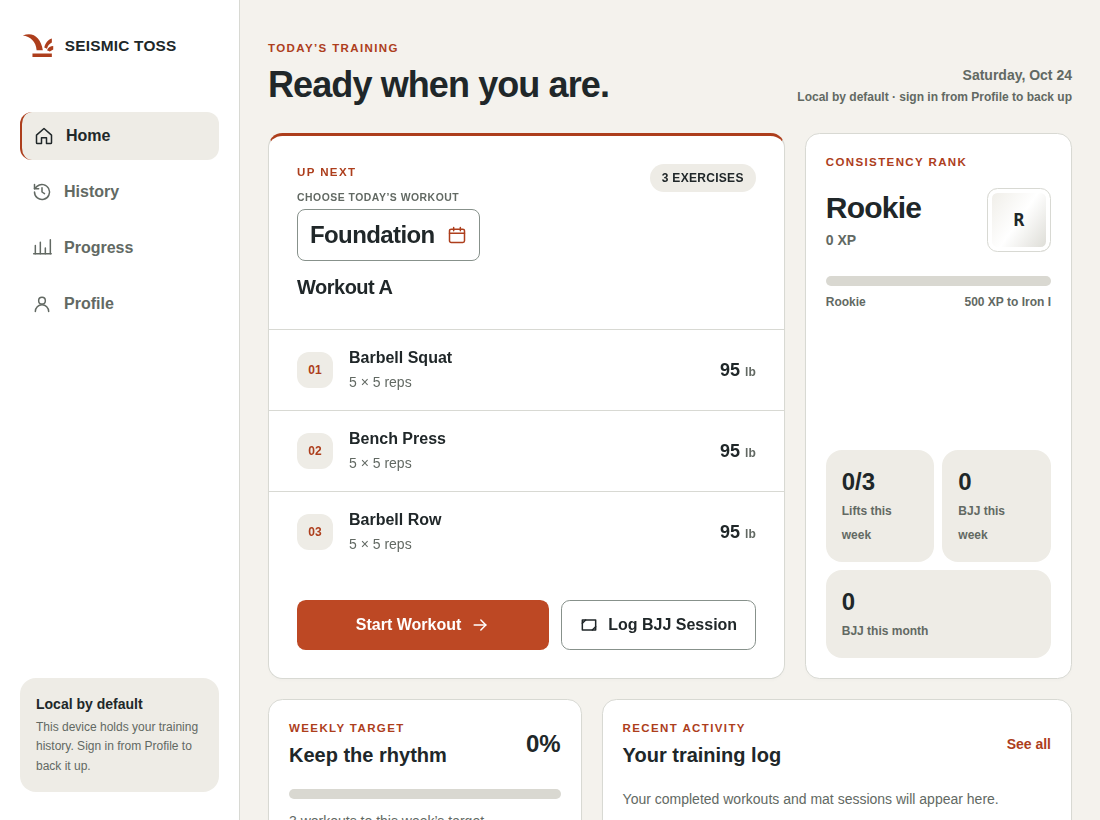
Seismic Toss

Progress that stays yours.

A training companion for strength, calisthenics, and time on the mat. Simple progression, one reliable record, and no account required to train.

The engineering question: can the product stay useful when the network does not?

Explore Seismic Toss
Seismic TossStrength. Movement. Combat.
Seismic Toss training interface showing a local training plan and workout controls.
One training record. Owned by the person doing the work.View full-size capture Local product capture

Notes from the lab.

Methods, boundaries, and what counts as evidence.

Research

Replay the evidence.

Deterministic replay

Why observation time, availability time, and the decision cutoff belong in different fields.

Simulation & Testbeds

A clear goal.
A measurable result.

Controlled environments let us evaluate planning, autonomy, adversarial behavior, reliability, and agent performance. Games are one useful class of testbed: measurable goals, repeatable scenarios, and clear failure states. Our game and experimental-software history dates to 2016.

Explore simulation & testbeds

Independent by design.

We use AI aggressively.
We also assume it can be wrong.

Generated work must survive the same things we expect from human engineering: tests, evidence, review, measurement, and failure analysis.

About Dark Packet